

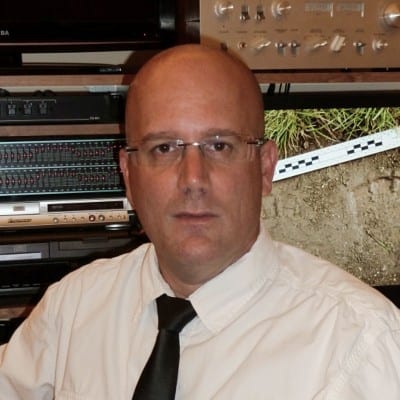

Doron Baldinger is an expert in authenticity examinations of images and photographs, including their interpretation, analysis and comparison, and the exposure of editing and forgery in them.
Over 20 years of experience.
Expert witness in the courts.
For an initial, no-obligation phone consultation, call 054-421-2424 or send a WhatsApp message. We would be glad to hear from you.
Digital images and photographs often serve as significant evidence in investigations and legal proceedings, hence the importance of examining their authenticity.
Thanks to the accessibility of social media and the prevalence of high-quality cameras in mobile phones, there is a dramatic and growing increase in the number of images and photographs submitted, time and again, as evidence in court and to investigative and law enforcement authorities, by citizens, witnesses and the security forces themselves.
Given how readily available advanced technologies and image-processing tools are, freely on the internet and even as apps installed on the mobile phones that are so widely available to the public, there is also a growing number of images and photographs submitted as evidence in investigations and legal proceedings after they have been altered and edited. In such circumstances, fabricated evidence may be submitted to the court, and it may pervert the course of justice when it is presented in investigation files and submitted in legal proceedings.
The courts, too, already understand and are aware of how easy it is to edit a digital image today, and so experts are frequently asked to analyse the authenticity of photographs and the originality of digital image files.
Thanks to advanced (scientific) tools and creative methods, it is indeed possible to verify information accurately and to conduct a thorough investigation of the authenticity of images and photographs, while ensuring the reliability and provenance of the digital files, and so to arrive at the factual truth(!), which is a cornerstone of today’s investigations and legal proceedings.
Given the accessibility, the ease and the wide range of editing and forgery options so readily available in the digital age, the number of forgery and fraud cases has begun to gather pace and is constantly rising. This is therefore the time to examine evidence with the latest tools and advanced technologies, in order to meet the new investigative challenges developing in the field of legal media.
Beyond detecting manipulation in digital files, it is no less important to present the findings to the court in a reliable and professional manner, so that the court can form its impression and decide whether or not to accept photographic evidence as reliable.
The advanced tools we use in the field of video and images are used by leading forensic laboratories, law enforcement authorities, military, security and government bodies around the world.
This is a powerful tool that includes dozens of filters designed to examine and detect forgery, editing and manipulation in images and photographs, both at the level of content and at the level of the digital characteristics and traces of the image file.
The expert, Doron Baldinger, is an electronics engineer by training and a high-tech veteran from the field of hardware development. That deep understanding of and extensive experience in technology, together with legal training and a unique specialisation in criminal law, make it possible to use the latest and most advanced technological tools in the world to arrive at the truth in this field as well.
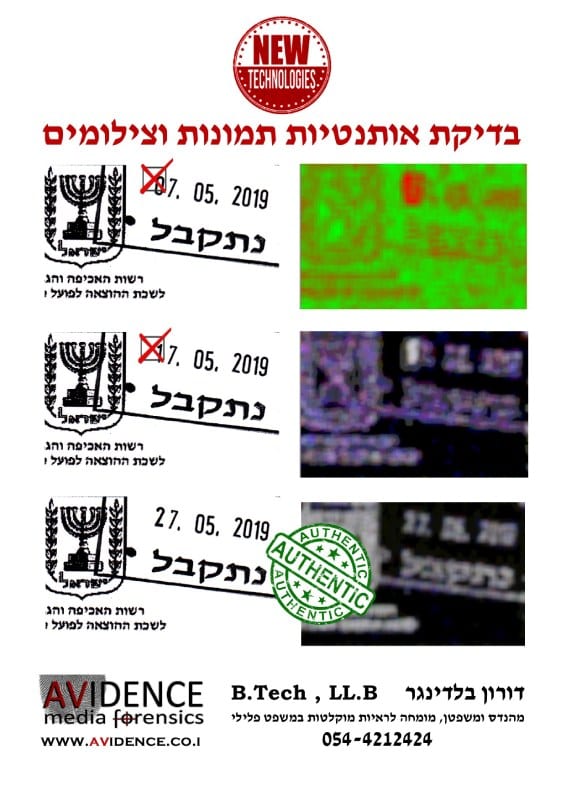
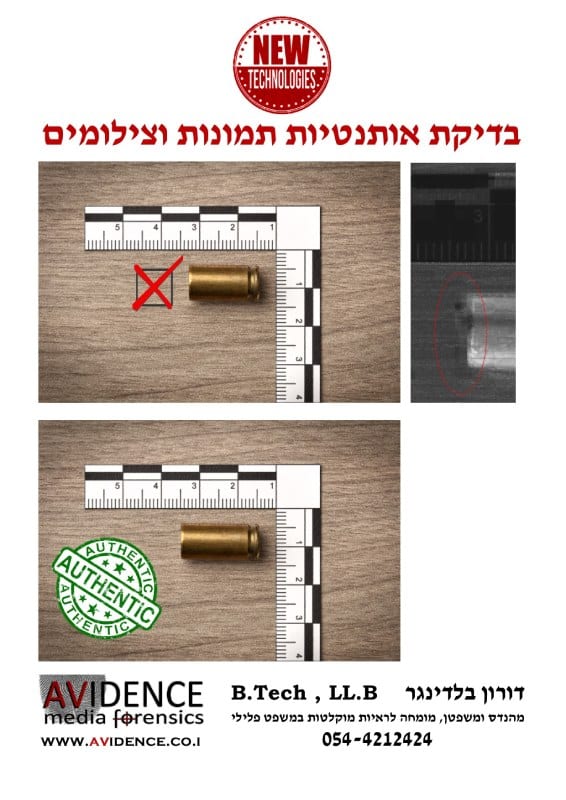
Below are two examples of forgery detection:
What is the correct date on which a document was received, and what will be the legal consequences of establishing it?
Detecting a forgery and establishing the authentic date on which materials were received at the Execution Office is a significant finding for the outcome of a civil case of this kind.
Which image is authentic and which is forged, and how will this affect determining the size of the bullet found at a shooting scene?
Detecting forgery in, or verifying the authenticity of, images and photographs from a crime scene can lead to the acquittal or the conviction of a criminal defendant.
Frequently asked questions
Can you tell if a photo was edited in Photoshop or with an app?
Yes. With advanced forensic tools, such as those used by forensic laboratories and law enforcement authorities, the originality of the image file is examined and signs of editing, splicing or forgery are detected.
Why do you need an expert to examine a photo submitted as evidence?
Because today it is very easy to edit a digital image, and the courts are aware of this. An expert verifies the file's provenance and reliability, and presents the findings in an expert opinion that the court can rely on.
What else is examined in a photograph besides editing?
Details in the photograph are analysed and compared, and what it shows is interpreted, in order to arrive at the facts themselves and not only at the question of whether the file was altered.


