


Doron Baldinger is an expert in conducting and analysing authenticity examinations of audio and video recordings, and in detecting editing and tampering in recordings.
Over 20 years of experience.
Expert witness in the courts.
For an initial, no-obligation phone consultation, call 054-421-2424 or send a WhatsApp message. We would be glad to hear from you.
Authenticity examination to detect editing or “doctoring” in audio and video recordings
In some cases, the parties to legal proceedings submit recordings to the court
Sometimes these are audio recordings of telephone calls or of various meetings, and sometimes they are combined video recordings made by various means. They may be private recordings made by the litigants themselves, recordings made by professionals such as private investigators, recordings made by insurance companies and the like, or even interrogation recordings made by the Israel Police in interrogation rooms, documenting the questioning and interrogation of suspects in criminal cases.
The purpose of presenting recordings in legal proceedings is usually to ground a party’s claims in solid evidence that, in its view, proves its version of events. Sometimes, however, the recordings have in fact been edited (“doctored”): they were tampered with after the fact and their content was altered, whether by adding or by omitting parts of the conversation. Such acts may amount to fabrication of evidence and may even lead to a miscarriage of justice.
Precisely today, in a technological world where a wide variety of editing software is “freely” available for download on the internet, extensive technical knowledge is not always needed to edit a recording. With relatively simple actions, various parties can “doctor” recordings that they then submit to the court as evidence, and so base their arguments on false and forged evidence.
(It should be noted at this point that “doctoring” recordings is in fact fabrication of evidence, which is a criminal offence in every respect.)
In such cases, where “doctoring” of recordings is suspected, a meticulous examination and an expert opinion are required to resolve the dispute over the recordings: whether they are original, and whether they were in fact edited or tampered with after the fact.
On the other hand, the opposite approach also exists: one party to the proceedings submits authentic audio or video recordings in order to support its claims, and the other party raises false allegations that the evidence is supposedly not authentic, without any basis. The aim is to have the lawfully submitted recorded evidence excluded, so that it cannot help the first party prove its version.
In such cases, too, an examination and a counter-opinion are required in response to the claims of the party that raised the dispute over the submitted recordings. The opinion will determine whether the recordings are indeed authentic and the allegation is false, or whether the recordings are in fact forged and should be excluded.
At AVidence we are experts in examining audio and video recordings, in detecting “doctoring”, edits and breaks in the continuity of a recording. We also know how to locate technical information related to the characteristics of the digital file, which sometimes shows that a particular file has been edited, converted or altered.
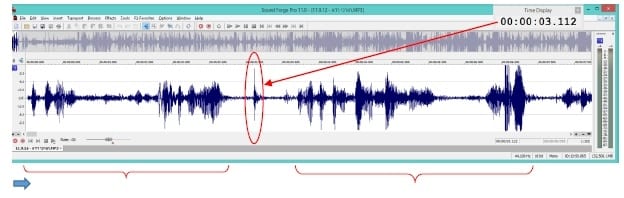
Audio recordings are examined meticulously at a resolution of thousandths of a second (1/1000 sec), and video recordings are examined at frame level (frame = 1/25 sec).
Where recordings were made in difficult conditions, we have the appropriate equipment to enhance them. We improve the picture quality of video and, for audio recordings, we improve the sound quality, reduce noise and bring the speakers’ voices to the fore.
We also submit expert opinions to the court. These can lead, on the one hand, to the exclusion of “doctored” recordings or, on the other, to the acceptance of recordings found to be authentic, which are then submitted as admissible evidence that sheds light on what happened and helps the court arrive at the truth and reach a just decision between the parties’ claims.
Below is an example in which a defect in a recording was detected by examining the time axis at a resolution of thousandths of a second (1/1000).
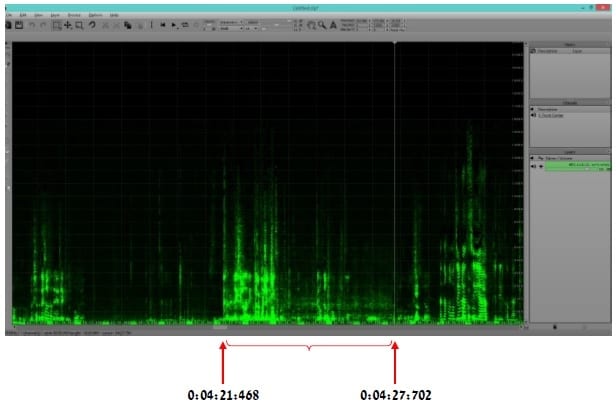
Below is an example in which a segment that had been inserted and planted into another recording was detected by identifying the change in background noise, examined on the frequency axis.
Frequently asked questions
How can you tell if a recording has been edited or "doctored"?
The recording file itself is examined: audio recordings at a resolution of thousandths of a second, and video recordings at the level of the single frame (1/25 sec). We look for breaks in continuity, changes in background noise that indicate a planted segment, and traces of editing, conversion or alteration in the digital file.
The other side claims my recording is fake. What can I do?
Request an authenticity examination and a counter-opinion. The opinion determines whether the recording is authentic and the allegation against it is false, or whether it was in fact edited. This way, a genuine recording is not excluded just because the other side challenged it.
Is it a crime to "doctor" a recording?
Yes. Submitting an edited recording as evidence is fabrication of evidence, a criminal offence in every respect. When such a suspicion arises, a meticulous examination and an expert opinion are required to establish whether the recording is original or was tampered with after the fact.


