


Doron Baldinger is an expert in speaker recognition engine examinations and voice comparisons. Over 20 years of experience.
Expert witness in the courts.
For an initial, no-obligation phone consultation, call 054-421-2424 or send a WhatsApp message. We would be glad to hear from you.
Voice comparison and speaker identification in recordings have become one of the key elements in examining recorded (audio) evidence.
In the past, litigants tried to attack recorded evidence submitted against them on the level of the authenticity of the recording file, and to prove that the file had been tampered with after the fact by editing (or “doctoring”, in everyday language). Today, when they face a recording in which they have found no suspected defect, they may choose a different legal argument and say: “That’s not me on the recording.”
This, in effect, is how two parallel routes for challenging recorded evidence submitted by the opposing party emerged and developed:
A. Examining the authenticity of the recording file, whether on the level of formal admissibility (whether the recording meets the test of the Wiretap Law), on the level of technical admissibility (whether the recording file meets the tests of technical reliability, and whether it is an authentic, original file, or whether there is a suspicion that the recording is not an original at all, or is only a partial derivative of the original), or on the level of substantive admissibility, examining the content of the recording itself for continuity, and even examining suspicions of editing or “doctoring”, omission of segments, joining of different recordings and/or additions to an existing recording, and more.
B. Examining the identity of the speakers recorded, and addressing the question of whether the voice heard on the recording is in fact the person who is alleged to have been recorded, or not.
The great advantage of using a speaker recognition engine is that it is a very advanced technological tool that offers a relatively fast (seemingly “automatic”) solution for examining and comparing the voice tracks under examination against voice samples of known speakers that we need to verify them against.
A further advantage of the more sophisticated speaker recognition systems is that they can sometimes run several parallel comparisons against the same questioned recording sample, producing in effect an output of the comparison gaps between several recordings and different speakers whose voices were examined. This makes it possible to decide which of them is worth focusing the examination effort on at a more advanced stage, while the others can be ruled out at the outset.
On the other hand, the fundamental drawback of the “speaker recognition engine” method is that, in most cases, the identification does not reach a 100% level of certainty. It is therefore sometimes necessary to continue and deepen the examinations: through additional voice derivatives, by making deliberate recordings to sample the voices of the relevant speakers, and by using additional forensic software that allows a more meticulous examination. This software is designed for experts in the field and allows various “manual” examinations that are more focused and complex, well beyond the sophistication of the “automatic” parameters that a “speaker recognition engine” system offers.
One could even say that a speaker recognition engine is better at excluding a person suspected of being the speaker in a particular recording than at providing a positive identification.
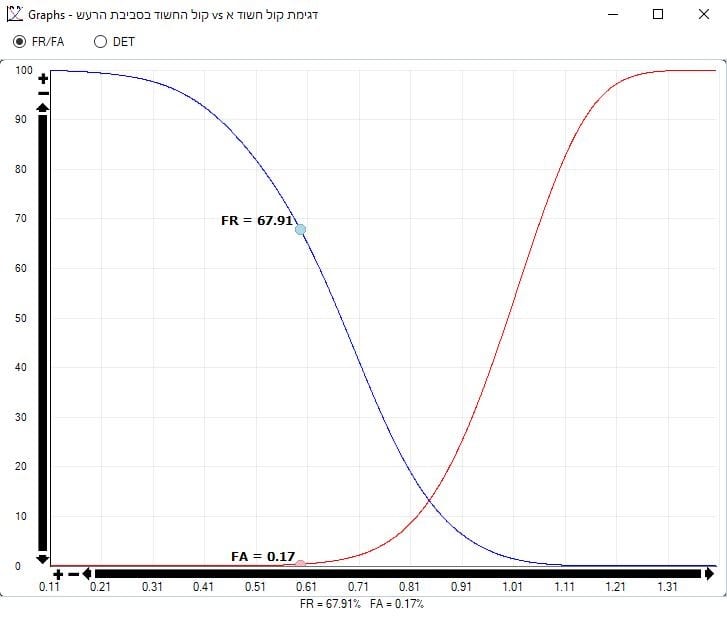
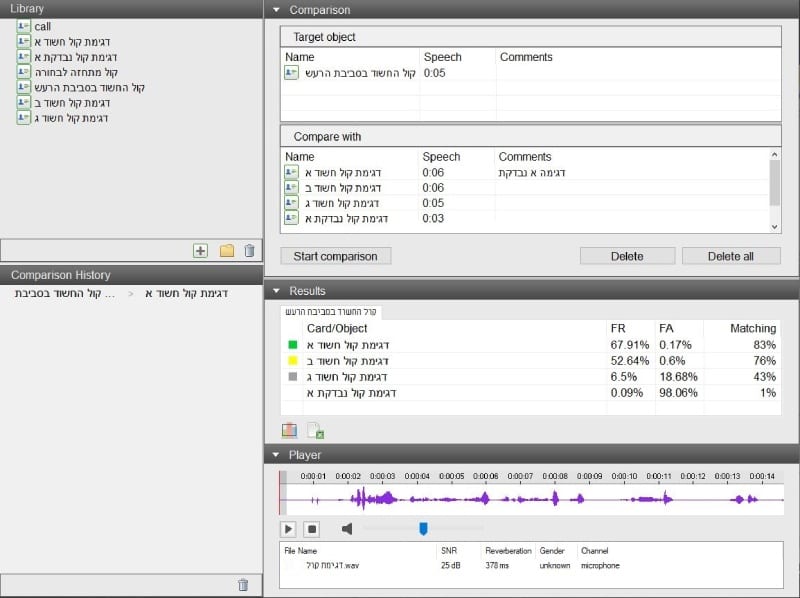
For example, to illustrate with numbers:
There is no doubt that a speaker identification match of 83% is considered a match. But clearly, this is not the quality of match we would want to find in order to argue “this is the man.”
To present a match (particularly in criminal proceedings), it must be shown that the match is high, 90% or above, or even higher. In certain cases we have reached matches as high as 99.95% with the “biometric speaker identification” system we work with.
Clearly, the higher the match percentage, the higher the level of certainty, and this can decide outcomes in legal proceedings.
But let us return for a moment to the meaning of an 83% match result…
What does it mean?
An 83% match is a result that, in principle, also “warns” us of a 17% non-match. In criminal proceedings, this may sometimes (in the absence of other evidence) be enough to raise reasonable doubt. In such cases, the examinations must be taken further with the “manual” tools, which allow the expert to extend the examination to additional parameters and additional voice frequencies.
By contrast, when it comes to excluding a suspect as the speaker on a recording, even a 20% match (which is in fact a relatively high non-match of 80%) can help a person prove that they are not the suspect who was recorded. In our experience, it is also sometimes possible to reach results of between 3% and 0%, which represent a high level of “non-match” and lead to the clear conclusion: “this is not the man.”
At AVidence, we use two main tools designed for voice comparison (in addition to the many other tools at our disposal):
A. A biometric(!) speaker recognition engine – allows examination of voice characteristics and comparison of a questioned voice sample against several voice samples of different speakers, and outputs the match percentages (and non-match percentages) between the different speakers and that voice sample. For comparison, the speaker recognition engine requires recording segments containing at least 3 seconds of net speech. (This refers to speech time, not recording time, since a recording also contains pauses in sound, pauses in speech, waiting times and so on…)
To improve the precision of the examinations, it is recommended to identify identical words or sentences in the recordings being examined. The more such words or sentences can be found, the more accurate and reliable the results will be, and the more conclusive the match / non-match results.
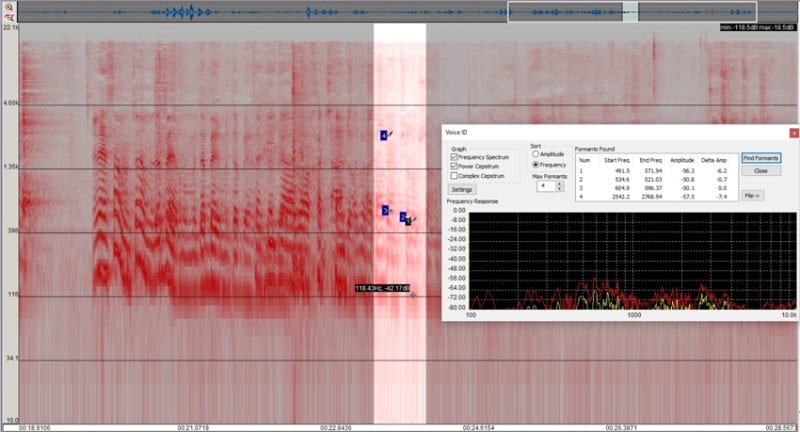
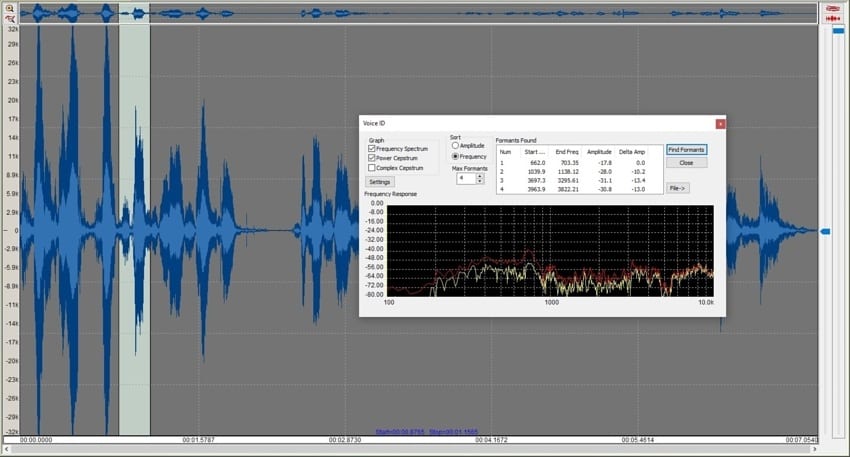
B. Forensic software for voice examination and comparison – gives the expert a wider range of examinations. This tool allows speaker identification comparisons even at the level of a single word or syllable. It also allows the examinations to be refined across various parameters, producing comparison results on voice frequencies, voice intensity and more, across a larger number of sampling points.
Whereas a speaker recognition engine produces a “match” / “non-match” result as a percentage, the additional forensic software can present a broader sample of results, including various graphs.
Unfortunately, over the years various experts have emerged who chose to rely on various “automatic” speaker recognition engine tools despite their limitations, and even though their understanding of the field and the related technology may be limited. These experts have at times led courts to findings in which they chose to disregard the limited match levels presented to them, to the point that the courts mistakenly held that, with all due respect to the voiceprint, it cannot be given a value comparable to that of a fingerprint.
The expert, Doron Baldinger, is an electronics engineer by training and a high-tech veteran from the field of hardware development. That deep understanding of and extensive experience in technology make it possible to use the latest technological tools at the highest level and to arrive at the truth in this field as well.
At this point it is important to note that the tools at our disposal can also analyse the vibration frequencies of the vocal cords, and as such these tools do have biometric capabilities. Even if a person can “change” their voice to the point of sounding like someone else, this is still only a change resulting from variations in voice intensity, in speech rate, and in the “resonance chamber” by changing the position of the jaw and/or the shape of the tongue inside the mouth while speaking. But a person cannot change the frequencies of their vocal cords, which differ from person to person and depend on their physiological structure.
Vocal cord frequencies differ according to the length of the vocal cords and their shape, as well as various other factors (for example, the presence of a growth or polyp on the vocal cords, and the like). The vibration frequencies of the vocal cords are a biological given that differs from person to person. Therefore, an expert who knows and understands the power of these parameters, and who also holds the appropriate examination tools and knows how to work with them, can bring the court results of greater value and significance.
Frequently asked questions
How do I prove that the voice on a recording isn't mine?
The voice on the recording is compared with known samples of your voice, using a biometric speaker recognition engine and additional forensic software. A low match supports the claim that you are not the recorded speaker, and sometimes the result is a clear "this is not the man".
Does speaker identification give 100% certainty?
Usually not. A speaker recognition engine gives a match percentage, so further, more in-depth examinations are sometimes carried out: deliberate recordings of the speakers' voices, examination of additional voice derivatives, and dedicated forensic software.
What is the difference between an authenticity examination and speaker identification?
An authenticity examination checks the file: whether it is original, continuous and unedited. Speaker identification checks who is speaking: whether the voice on the recording really belongs to the person alleged to have been recorded. These are two separate routes for examining recorded evidence.


